


I'm going to take you on a journey from our distant past, at the end of the last ice age, up to the present day, showing how our lives are being affected by a fast changing climate - and - how the way we live is changing the climate.
You’ll meet with people working to restore the climate back to how it used to be, using science but you'll also see how everyday people can make a positive difference by making changes to the way they live.
The subjects covered in this session will be looked at in greater detail in later sessions.
The future of our planet will one day be in your hands, so it's important for you to understand what our real options may be.
Stories about climate change and the weather are in the news all the time and I’m sure many of you have been affected by the weather at one time or another. The climate is changing and the world we live in is changing with it.
Welcome to the Climate Learning Sessions. My name is Kelsi Umeko and I’m here to help you make sense of what’s going on with the climate in simple, easy to understand terms.
To get a clear understanding, it’s really helpful to go back in time and explain how things used to be, how they are now – and how things may be in the future.
1. IN THE BEGINNING >>>
At the end of the last ice age, roughly 12,000 years ago, Earth’s climate warmed and stabilized after tens of thousands of years of harsh freezing, glacial conditions. This warm period is known as the Holocene. As ice sheets retreated, sea levels rose, ecosystems rebounded, and previously frozen regions became fertile landscapes rich in plants and game. An ecosystem is where living things like plants and animals work together with non-living things like water, sunlight and rocks, to form a single environment.
This climatic stability created the first dependable environments in which humans could settle for longer periods, experiment with plant cultivation, and domesticate animals. The resulting shift from nomadic hunting and gathering to early farming and permanent communities sparked population growth, technological innovation, and the gradual rise of complex societies.

VIDEO 1 >>>
2. THE INDUSTRIAL REVOLUTION >>>
Over these 12,000 years, these complex societies rose and fell, but around 1760, humanity entered a period of unprecedented change when people learned to harness the power of machines to make things bigger, better and faster. this is what's referred to as the Industrial Revolution, a new era of mechanical energy that rapidly transformed industry, transport - and daily life.
Fossil fuels like coal and later oil were the fuels powering these machines, and it was these fossil fuels that would lead to rapid economic growth and mark the beginning of large-scale carbon dioxide emissions. This new era, in which humanity became a dominant force shaping the planet’s atmosphere and ecosystems, is what we refer to as the Anthropocene.

VIDEO 2 >>>
3. THE BENEFITS AND CHALLENGES >>>
The industrial revolution brought many benefits to society but these benefits came at a price. There were social costs, as well as to the environment and climate.
Some of the positive outcomes included: Economic growth & productivity, improved transportation, technological innovation, Urbanization & job creation & more...
Some of the not so positive outcomes included: Harsh & unsafe working conditions, exploitation of labor, pollution & more...

4. ABOUT CARBON >>>
You hear a lot about how carbon and carbon dioxide is a big problem for the climate - and it is. But it's not that simple...
You see, our relationship with carbon is complicated… Carbon is the building block of life – nearly all life on earth is based upon carbon and we use carbon in so many everyday things. From batteries to filters to remove pollution, to diamond tools and jewellery, to ultra-strong carbon fibre.
Vegetation absorbs carbon from the atmosphere, and with the help of sunlight, it turns the carbon into more vegetation. When the vegetation dies, much of its carbon remains in the ground, and over thousands and millions of years, it turns into oil and in some cases, coal.
So just like so many other things in life, it's all about how much is enough, and how much is a bad thing.

5. TOO MUCH OF A GOOD THING >>>
A good example of this is when two of the elements most important to life, oxygen and carbon, cause problems when they combine in large quantities.
When burnt, the carbon in the coal or oil, reacts and bonds with oxygen in the air to form carbon dioxide. And this is where the challenge lies.

Animation overlay: Oxygen and Carbon bond to produce CO2
6. WHY IS TOO MUCH CO2 A PROBLEM? >>>
Water, when it evaporates and becomes clouds, is a greenhouse gas. It’s referred to as a greenhouse gas because just like a greenhouse, it helps keep in warmth from the sun, keeping the temperature of the planet more even.
You'll notice on a clear winter night with no clouds, it's always colder.
Carbon dioxide is also a greenhouse gas and when too much CO2 is released into the atmosphere, too much heat is trapped in, affecting nature’s balance. And that is what’s happening now – more and more CO2 is going into the atmosphere, making the atmosphere warmer and warmer.
So you see - again, it's all about how much is too much.

7. SO, HOW DO WE KNOW ALL THIS? >>>
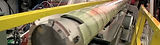
Ice core samples contain trapped air bubbles and a range of materials from the atmosphere. Scientists in Antarctica were able to drill deep enough to retrieve 800,000 years of ice-core records. Research shows there is a direct relationship between CO2 and temperature: as the CO2 levels go up – so does the temperature. As the CO2 levels go down, the temperature follows.
The samples cover over 800,000 years and show a clear cycle of warming and cooling, approximately every 100,000 years
Drilling is currently taking place to go deeper and further back in time.
8. ALL ABOUT THE DATA >>>
This graph below shows how the carbon dioxide (in Yellow) and the CO2 (in gray) rise and fall together.

9. NET ZERO: What it is, why we need it & why it isn't enough >>>
Getting to Net Zero means getting to a point where we only put in as much CO2 into the atmosphere as is being removed, so each year, there isn't more additional CO2. But even if we reached this goal today, it is not enough to stop the warming because there’s already too much carbon in the atmosphere.

10. SO, WHAT ARE THE ALTERNATIVES TO NET ZERO? >>>
There are no alternatives to reducing emissions. But… there’s a process called Climate Restoration that focuses on removing carbon from the atmosphere. It is an evolving science, designed to support nature and accelerate how carbon is removed from the atmosphere.

11. CLIMATE RESTORATION >>>
Climate Restoration is all about restoring and returning the climate to how it used to be before we started putting too much carbon into the atmosphere. We focus on 3 main types of climate restoration:
-
Atmospheric. Removing CO2 from the atmosphere or converting CO2 and Methane
-
Ocean based
-
Land based
Most of these methods are designed to support nature in how nature naturally removes and converts these emissions.

12. GOVERNANCE >>>
There are so many things to think about from a scientific point of view, and the way we live when deciding how research can be carried out and eventually, how it can be used: is it safe, what are the risks, what might it affect.
-
Who decides what is safe and what is possible
-
How do we address the injustices of the past?
-
How do we address inclusion
Equally important, how do we address the fact that the people in the world most affected by climate change are the ones that are least responsible and have the least say. This is referred to as climate Justice.

13. CLIMATE JUSTICE >>>
How do we address the injustice of the people in the world most affected by climate change? They are the ones that are least responsible and have the least say.
Sea level rise, drought, hurricanes, flash flooding. This is referred to as climate Justice.

14. WHAT CAN I DO? >>>
Science is essential to finding solutions to solving the climate crisis, but it's also important for us to look at our own behavior and the choices we make regarding how we live.
So at the end of each session, we'll look at two things:
-
How climate change may be affecting your community and
-
Suggestions on what you can do to have a positive effect on the climate.
Extreme weather
Do you think your country and/or community has been affected by climate change?
The weather is probably the most visible effect of climate change. We constantly hear about it.
Have you experienced:
-
Hurricanes
-
Flooding
-
Drought
-
Very high temperatures for long periods
-
Wildfires
If so, how has your community responded?

It may be big industry, agriculture, construction and transportation that are the big contributors to the growing amount of CO2 in the air, but we as individuals, families and communities can still make a positive difference.
So as far as how you may have been affected by a changing climate,
Depending on how fortunate or ‘well-off’ we are, there are probably ways to reduce the amount of carbon that we, personally are adding to the atmosphere. This is referred to as our carbon footprint. This is the amount of carbon that is released from doing the things we do each day. From this - - - -to this - - - . More details are given in the exercise that follows this session.
My life and my actions

Local context >>>
To conclude this first climate learning session...
The issues around climate change are enormous, but empowering yourself and others through a better understanding of what is happening and what are our real options will give all of us - but especially your generation, a better chance of creating a climate that all life can thrive in.
For further discussion >>>
How have your country and community benefited from industrialization? How might they have suffered?